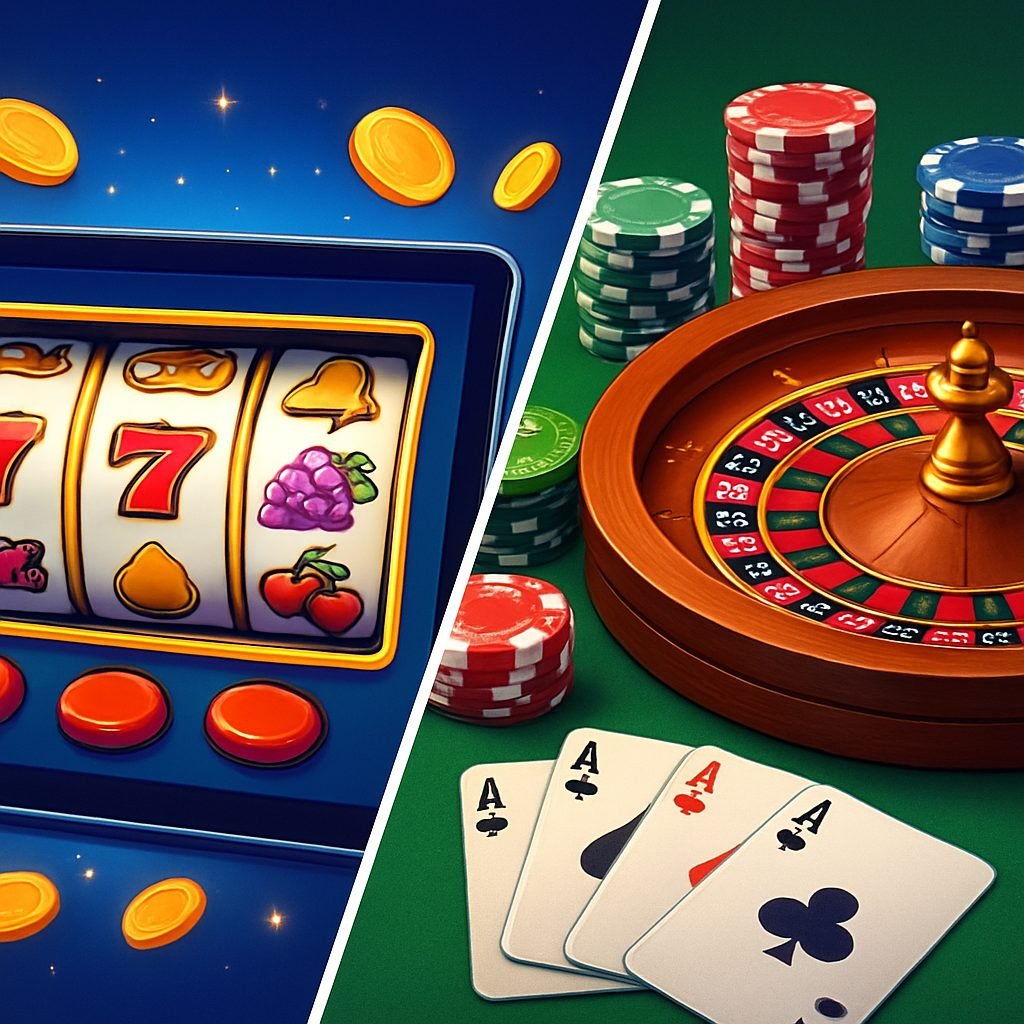
Online Slots vs. Table Games: Comparing Odds, Fun Factor, and Profitability
Choosing between online slots vs table games comes down to odds, volatility, and how much skill can influence results. This article compares RTP, house edge, and entertainment features with named game examples and simple math, then gives practical takeaways and a test plan you can run on GGLBETSG to match games to your bankroll and goals.
How odds work online: RTP, house edge, variance, and RNG
Straight fact: the percentage on a game page is not a guarantee you will win next session; it is a long-run average that tells you expected return, not short-term outcomes. Understand RTP, house edge, variance, and RNG together, and you stop treating advertised percentages as promises.
Core definitions and the simple math you will use
RTP and house edge: RTP is the percent of all wagered money a game returns to players over a huge sample. House edge is the mirror image: house edge = 100% – RTP. If a slot shows 96% RTP, the house edge is 4%.
- RTP example: Betting 100 SGD total on a 96% RTP game yields expected return 96 SGD and expected loss 4 SGD.
- Variance (volatility): Two games can share a 96% RTP but behave very differently. High variance means long losing streaks and occasional big wins; low variance means frequent small wins and steadier short-term bankroll movement.
- RNG and certification: Random number generators decide outcomes on RNG games. Look for independent testing badges such as eCOGRA to trust results and published RTPs.
- Skill matters for some games: Blackjack and video poker let you influence RTP with correct strategy; slots do not.
Practical formula: Expected loss = Total amount wagered × (1 – RTP). Use this for session planning. Example calculation below is what people forget when they see a single percentage and assume it applies to the next hour of play.
| Game | Typical RTP (example) |
|---|---|
| NetEnt Starburst (video slot) | 96.09% |
| NetEnt Gonzo's Quest (video slot) | 95.97% |
| Microgaming Mega Moolah (progressive slot) | Approximately 88%–92% |
| Blackjack (good rules, basic strategy) | ≈99%–99.5% RTP |
| European Roulette | 97.3% |
| Baccarat (banker bet) | 98.94% |
| Video Poker (full-pay Jacks or Better) | ≈99.54% with optimal play |
Concrete session example: You plan a 200 SGD session and will place 100 bets of 2 SGD each. On a 96% RTP slot your expected loss is 8 SGD (200 × 0.04). On a well-played blackjack table with 99.5% RTP your expected loss is 1 SGD (200 × 0.005). Those are expectations, not guarantees, but the scale difference is real and matters for bankroll planning.
Trade-off that matters: higher RTP with skill requires discipline. Blackjack offers better expected returns only if you apply correct strategy and choose favourable table rules. Many players underestimate the practical cost of rule variations such as 6:5 blackjack payouts or multiple decks; those rules can push house edge back up and remove the theoretical advantage of strategy.
Variance in practice: slots concentrate returns into rare big payouts. That is why progressive jackpot slots like Mega Moolah list lower RTPs; a slice of every bet funds the jackpot, reducing base game return. Even two non-progressive slots with similar RTP can feel different because hit frequency and average win size differ.
What players get wrong: people treat RTP as a session predictor. It is not. Short sessions are dominated by variance. The only time RTP reliably predicts your outcome is over thousands or millions of bets, which is not how recreational players typically play.
Real-world application: try a controlled test on the site before committing significant bankroll. Use demo mode on the GGLBETSG video slots page to run 100 spins and compare observed hit frequency to the published RTP, and use the live blackjack listings to check table rules first: Video Slots, Blackjack, Roulette. Track results in a simple spreadsheet.
Next consideration: pick your priority for the session. If you want steadier play and lower long-term loss, prioritise table games with good rules and apply strategy. If you want spectacle and chance at a large jackpot, accept lower RTP and higher variance on slots, and budget accordingly.
Side-by-side statistical comparison with concrete game examples
Direct claim: When you put numbers next to each other, table games almost always win on long-term value while slots win on volatility and spectacle. The following comparison shows why that split exists in practice and what it means for single-session decisions.
Quick numerical snapshot
| Game (example) | Typical RTP | Implied house edge | Expected loss per 1000 wagered | Short-term volatility |
|---|---|---|---|---|
| NetEnt Starburst (video slots) | 96.09% | 3.91% | 39.10 | Medium |
| NetEnt Gonzo's Quest (video slots) | 95.97% | 4.03% | 40.30 | High |
| Microgaming Mega Moolah (progressive) | 88% – 92% | 8% – 12% | 80 – 120 | Very high |
| Microgaming Immortal Romance (video slots) | 96.86% | 3.14% | 31.40 | High |
| Blackjack (basic strategy) | ~99.5%* | ~0.5% | 5.00 | Low – Medium |
| European Roulette | 97.30% | 2.70% | 27.00 | Medium |
| American Roulette | 94.74% | 5.26% | 52.60 | Medium |
| Baccarat (banker bet) | 98.94% | 1.06% | 10.60 | Low |
| Video Poker Jacks or Better (full-pay 9/6) | 99.54% | 0.46% | 4.60 | Low – Medium |
Note on the numbers: Expected loss per 1000 wagered is a straightforward translation of RTP to money out of your stake pool. It is not a promise of what will happen in a short session – variance changes the path but not the long-run average.
Practical tradeoffs that matter
- RTP versus volatility: Two games can have similar RTPs but wildly different session behaviour. Starburst returns frequently but with smaller hits; Gonzo's Quest and many modern slots promise larger bonus payouts but longer cold runs.
- Progressives reduce base RTP: Progressive jackpot slots like Mega Moolah allocate a slice of every bet to the pool. That inflates the jackpot but reduces base game RTP – a conscious tradeoff between jackpot chance and routine value.
- Skill changes the math on tables: Blackjack and video poker let you reduce house edge through correct decisions. That makes expected loss per wager fall and gives room for positive decision-making, unlike slot machines which are pure chance after game choice.
- Rules and variant effects are real money differences: A blackjack table paying 6:5 instead of 3:2 or a multi-deck game can double or triple the house edge versus an optimally ruled table. Always check rules before you sit; GGLBETSG lists table limits and variants on its Blackjack page.
Concrete example – single-session decision: You have a 100 bankroll and want a two-hour session. Betting $1 spins on Starburst gives a theoretical loss of about $0.39 per 10 spins (based on RTP), but you can expect long losing streaks and occasional small wins. Choosing $2 hands in blackjack with basic strategy and favourable rules yields expected loss under $1 for that same wage volume and a steadier ride. If your goal is entertainment and chasing bonuses, pick slots. If your goal is preserving bankroll and stretching play, pick table games.
What most players misunderstand: People assume published RTP means their session will look like that percentage. It does not. RTP is a long-run average across millions of bets. For practical decisions you must combine RTP with volatility and bet size. High RTP on a high-volatility slot can still produce worse short-term outcomes than a lower-RTP but low-volatility table game.
Judgment call: If you prioritise long-term value and control, allocate most of your regular-play bankroll to low-house-edge table games and video poker and use a small entertainment slice for high-volatility slots and jackpots. If your priority is spectacle and the thrill of rare big wins, accept the higher expected loss and smaller average return per wager.
Profitability in practice: expected value, variance, and bankroll examples
Key point: Expected value tells you the long run, variance tells you what happens in a single session. For anyone deciding between online slots vs table games, the arithmetic of expected loss is simple, but the lived experience depends on variance and bet sizing.
Expected value worked examples
Concrete math: If a game lists RTP 96%, that means for every 100 units wagered the long-run expected loss is 4 units. Put another way, total wagered x (1 – RTP) = expected loss. This is the number operators use to size payouts and guarantees the house edge over time.
| Game example | RTP / House edge | Sample betting plan | Total wagered | Expected loss |
|---|---|---|---|---|
| Video slot (Starburst style) | 96.09% | 100 spins x 1 unit | 100 units | 3.91 units |
| Blackjack with good rules and basic strategy | 99.5% RTP (approx) | 100 hands x 10 units | 1,000 units | 5 units |
| European Roulette – even money | 97.3% RTP | 100 bets x 1 unit | 100 units | 2.70 units |
What this shows: A higher RTP reduces expected loss per wager, but expected loss scales with total amount wagered. Blackjack matches or beats many slots on pure expected value when played with correct strategy, but it requires discipline and rule selection.
Variance, session outcomes, and why house edge can feel irrelevant
Practical insight: Short sessions are dominated by variance, not expected value. For many common bets the standard deviation per bet is roughly the size of the bet. That means after 100 bets your typical swing is on the order of 10 bet units, which often dwarfs the few units you expect to lose from the house edge.
Implication: Choosing a low house edge game is necessary for long-run profitability but not sufficient to avoid unlucky runs. You must manage bet size and session length to survive variance.
- Rule of thumb: For even-money bets like roulette red/black, expected loss after n bets = n x house edge. Standard deviation approx equals square root of n times bet size.
- Slots tradeoff: Video slots often have larger payout tails – lower hit frequency but occasional large wins. That increases standard deviation dramatically compared with even-money bets.
- Skill matters: Games where skill reduces house edge – blackjack, video poker – convert variance into a smaller long-term leak, but they do not eliminate short-term swings.
Bankroll sizing examples and recommended session rules
Concrete use case: A recreational player brings 200 units to a session and wants entertainment over three hours. If they pick slots at 1 unit spins, that bankroll supports 200 spins. Expected loss at RTP 96% is about 8 units, but variance means they could be up or down 50 units in reality. The same 200 units spread as 40 blackjack bets of 5 units each reduces the number of decisions but concentrates variance per decision differently – expected loss will be lower if basic strategy is used, but swings still happen.
- Conservative recreational rule: Keep unit size to 1% or less of bankroll for table games, and 0.5% to 1% for high-volatility slots if you want to avoid rapid depletion.
- Session stop rules: Set a loss limit and a win goal expressed in units – for example stop if down 30% or up 50% of starting bankroll. These rules prevent chasing and reduce the chance variance erodes your bankroll.
- Reserve buffer: For low-variance, strategy games have value if you can play many hands. Aim for at least 100-200 units relative to your unit bet to reduce bust probability. For high-volatility slots, plan 300-500 units if you want a real shot at a big win without immediate ruin.
Real-world test you can run: Use Online Slot Games demo mode for 100 spins at your intended stake and log results. Do the same on a low-house-edge table via Blackjack Games Online for 200 hands using basic strategy. Compare observed return and volatility – this empirical test beats theoretical arguments for most players.
Important – variance will determine whether you walk away a winner in a session. Expected value matters for long-term planning; variance and bet sizing determine session survival and enjoyment.
Next consideration: Decide whether your session goal is entertainment or smallest expected loss, then pick game type, unit size, and session limits to match. For practical guidance on rules that change house edge in blackjack consult Wizard of Odds.
Fun factor and user experience: what makes each category entertaining
Direct point: entertainment in online slots vs table games is not about which is more fun overall but about what kind of thrill you want and how you want to spend your time. Slot machines trade spectacle, variety, and instant gratification. Table games sell interaction, decision making, and a steady rhythm.
What slots deliver: spectacle, features, and momentum
Key mechanics: video slots lean on theme, animation, sound design, and layered feature cycles – free spins, cascading reels, respins, and bonus rounds keep the player engaged between wins. These mechanics create short loops of anticipation and release that feel rewarding even when the math favors the house.
Practical tradeoff: the same features that make slots exciting also mask long losing runs. High volatility slots give massive peaks but long dry spells; low volatility slots give steady small wins but lower ceiling. Choose features to match session length – pick high hit frequency for long evening play, high volatility for short thrill-focused sessions.
- Attention hooks: Cinematic intro, near miss animations, and escalating bonuses keep players clicking.
- Simplicity: No strategy required – pick round length and volatility then watch the show.
- Variety: With 14,500+ video slots available, you can chase themes, mechanics, or jackpots without changing platforms. See GGLBETSG video slots page for options: Online Slot Games: 14,500+ Video Slots Singapore | GGLBET.
Concrete example: a 30 minute session with 20 SGD aimed at entertainment works well on a low to mid volatility slot like NetEnt Starburst. You get steady small wins and repeated bonus animations without needing to learn rules. If you want the potential of a big hit, switch to a progressive like Mega Moolah but accept longer cold streaks and lower base payout rates.
What table games deliver: pace, skill, and social signal
Key mechanics: table games such as blackjack, roulette online, and baccarat structure play around decision points, visible outcomes, and social cues from live dealers. Those elements create a different kind of engagement – cognitive involvement, reading patterns, and social interaction in live dealer games.
Practical insight: table games feel more skillful even when probabilities dominate. Blackjack and video poker reward informed decisions; live tables reward situational awareness and can reduce boredom through social chatter and table limits that control session intensity. If your goal is a measured session with decisions, table games are superior.
- Pacing: Hands and rounds set a natural rhythm for breaks and bet sizing.
- Social interaction: Live dealer and multiplayer tables recreate the social currency of a casino floor.
- Skill expression: Basic strategy in blackjack or disciplined sizing in baccarat changes how satisfying wins feel.
Concrete example: a player with a 1 hour session and 50 SGD who wants controlled variance should use low stakes live blackjack with favourable rules. Check table limits and rules on GGLBETSG: Blackjack Games Online Singapore: 251 Live Tables | GGLBET. Use smaller bet sizes and focus on decision quality to stretch play time and keep engagement high.
Judgment that matters: many recreational players misunderstand engagement for value. Slots can feel more exciting but deliver less predictable entertainment per dollar spent. Table games reward discipline – you will often feel more in control and get more session time from the same bankroll when you accept the slower pace.
UX considerations that change real enjoyment: mobile design and latency matter more for live dealer games – lag breaks immersion. For slots, pay attention to feature clarity and volatility indicators at the provider page. Always test in demo mode first to confirm the sensory experience and stake comfort.
Final practical rule: if you want to maximise perceived fun per hour with a small bankroll, start in demo mode on slots or low stakes live tables, then move to real money with clear stop rules. If you want social gaming and the satisfaction of applied skill, allocate more time to live tables and bring a simple strategy card. For fairness and certification checks consult eCOGRA.
Which to choose based on player goals and profiles
Choose by objective, not by habit. If your session goal is entertainment, pick differently than if your goal is to minimise expected loss or chase a big jackpot. The trade-offs are predictable: slots buy spectacle and volatility; table games buy better long-term RTP and skill leverage but cost time and attention.
Player profiles and recommended choices
- Casual spinner (entertainment, low time commitment): low-to-medium volatility video slots such as Starburst deliver steady play, clear bonus rounds, and mobile-friendly sessions. Use demo mode first to test hit frequency.
- Jackpot hunter (big payout focus): progressive jackpot slots like Mega Moolah are the realistic option. Accept lower base RTP and long cold runs as part of the trade-off for occasional life-changing wins.
- Value-seeker/strategist (minimise expected loss): blackjack or full-pay video poker with sound strategy. These games can materially reduce house edge but require learning table rules and discipline on bet sizing.
- Social player (interaction, live table feel): live dealer blackjack and roulette give social cues, chat, and a slower tempo — good for multi-hour sessions that prioritise social engagement over raw EV.
- Low-bankroll, long sessions (stretch entertainment): low-stakes tables or low-volatility slots. Table games can be more predictable per bet, but minimums and seat competition matter.
Practical insight: mobile convenience usually favours slots. If you want short bursts during commute or on phone, video slots and classic slots are better tuned to that use case than live dealer tables, which rely on stable video and often have higher minimums.
Trade-offs that matter in practice
Skill versus time cost. Blackjack and video poker lower the house edge, but that advantage only exists if you invest time to learn basic strategy and choose favourable rules. Many players overestimate how quickly that returns value; if you play infrequently, the time cost can outweigh the small EV improvement.
Variance vs experience. High-volatility slots create memorable moments but inflate short-term variance — that is why sessions can feel dramatic but bankrolls swing wildly. Table games smooth the ride but are less likely to produce headline wins that feel entertaining.
Operational constraints. Real platforms have limits: table minimums, player seats, and varying payout rules (3:2 vs 6:5 blackjack). Always check table rules before you sit. Use the GGLBETSG live pages to compare limits and rules: try video slots, roulette, and blackjack.
Limitation to be honest about: choosing table games for EV only works if you can maintain disciplined, consistent play. Human factors — tilt, impatience, misunderstanding of rules — often erase the theoretical edge in real sessions.
Concrete example: A Singapore player brings a SGD 200 bankroll and 3 hours for play. If they choose low-volatility Starburst-style slots at SGD 0.50 a spin and average 400 spins, total wagered equals SGD 200; at ~96.09% RTP expected loss is roughly SGD 7.80 for the session, but variance may produce a wide range of outcomes. The same bankroll used at a low-stakes blackjack table with a 0.5% house edge and similar total wager yields an expected loss near SGD 1, but the player needs basic strategy and uninterrupted focus to realise that advantage.
A quick decision flow to use before you deposit
- State your primary goal: entertainment, profit control, or jackpot chase.
- Check bankroll and session time: smaller bankrolls favour low-volatility slots or micro-stakes tables.
- Assess skill willingness: if you will study basic strategy, prioritise blackjack/video poker; otherwise accept slots for convenience.
- Confirm house rules and limits on GGLBETSG: payout structure for blackjack, RTP and volatility indicator for slots, and live table minimums.
- Run a short demo or small real-money trial (100 spins or 50 hands) and record outcomes before scaling bet size.
Where to learn more. If you want to check expected outcomes and rules, consult testing resources and fairness statements — for platform certification look to bodies such as eCOGRA and for responsible limits see GambleAware.
Next consideration: pick one game aligned to your profile, run a short controlled test, and treat the result as data — not proof. Adjust choices based on how the game matches your goals in actual sessions.
How to test slots and table games on GGLBETSG
You can get a reliable read on whether a game suits your goals with a short, structured test on GGLBETSG rather than relying on impressions. Testing lets you compare observed behaviour – hit frequency, average win, and short-run RTP – across video slots and live table games using the same bankroll and time budget.
Step-by-step testing plan
- Pick a clear objective: decide if you are testing for entertainment value, volatility, or long-term value. That choice sets sample size and metrics.
- Choose the games and find their pages on GGLBETSG: use the video slots page for demo spins, and the online blackjack and roulette pages for live tables. Check published RTPs and table rules before you begin.
- Set fixed bets and a fixed sample size: for slots start with 500 spins at a realistic stake; for blackjack run 200 hands using basic strategy at a consistent bet size; for roulette use 500 single-number or column bets depending on your angle.
- Record every outcome: log spin/hand number, stake, net result, cumulative wager, cumulative return. Use a simple spreadsheet or the template below.
- Calculate observed metrics: observed RTP = cumulative return / cumulative wager. Also track hit frequency and largest single win or loss.
- Interpret with sample-size caution: compare observed RTP to advertised RTP but expect variance. Decide whether to continue, change stake, or move to a different game.
Practical insight: slots need much bigger samples to show the advertised RTP because of high volatility and rare bonus hits. Table games give clearer signals faster when you control the strategy and keep bet sizing consistent.
What to measure and why it matters
- Observed RTP: tells you short-run performance but converges slowly for high-volatility slots.
- Hit frequency: useful for entertainment decisions – frequent small wins feel better even if RTP is lower.
- Average win size: distinguishes frequent small payouts from rare big payouts – important for bankroll planning.
- Max drawdown: shows worst losing streak in the sample and helps set stop-loss rules.
- Rule confirmation for table games: verify blackjack pays 3:2, dealer stands on soft 17, and deck count – these materially change house edge. See strategy details at Wizard of Odds.
Limitation and trade-off: demo play can reproduce RNG behaviour but often omits real-money psychology and some promotions. Running tests with real money introduces risk but gives accurate limits and volatility under realistic stakes.
Concrete example: test NetEnt Starburst by running 500 spins at SGD 0.50. Total wager = SGD 250. With Starburst RTP 96.09% expected return = ~SGD 240.23, expected loss ~SGD 9.77. Your observed return after 500 spins might be higher or lower; a +/-10% deviation is common on that sample size. For blackjack, run 200 hands at SGD 5 using basic strategy: total wager = SGD 1000; with a well-ruled game near 99.5% RTP expected loss ~SGD 5, and observed RTP will usually be closer to expectation over that sample because variance per hand is lower.
| Test | Recommended sample | Why it helps |
|---|---|---|
| Low-volatility video slot | 500 spins | Shows hit frequency and bonus occurrence |
| High-volatility jackpot slot | 2,000+ spins | Needed to encounter rare large payouts |
| Blackjack with basic strategy | 200 hands | Detects rule impact and verifies expected house edge |
| Roulette (single-bet style) | 500 bets | Clarifies short-term variance and payout distribution |
Do not expect demo results to predict a single session. Use tests to compare relative behaviour between games, not to forecast wins.
Judgment call: in practice, you will get actionable intel faster from table games if you want low-variance, value-oriented play. For entertainment or jackpot chasing, slot testing tells you whether the excitement level matches the risk – but expect a longer sample and larger bankroll swings.
Next practical step: download the sample spreadsheet, run the chosen test on the linked GGLBETSG pages, and compare observed RTP and hit frequency to the advertised RTP. If you want independent assurance of fairness check for certification badges like eCOGRA. If testing affects your mood or bankroll, pause and consult GambleAware.
Responsible play, transparency, and next steps
Clear bottom line: responsible controls and platform transparency are the only reliable ways to turn a fun session into a sustainable one. Whether you favour online slots or table games, you are trading entertainment against financial risk, and the difference between an acceptable loss and a harmful loss is process, not luck.
Practical rules for responsible sessions
- Always set a session loss limit before you log in: lock the amount in your head and on the platform where possible; stop when it hits that number.
- Use deposit and cooling-off tools: prefer daily or weekly caps instead of ad hoc top-ups; these blunt the impulse to chase big wins.
- Set a time limit: shorter sessions reduce the chance variance drifts you into risky behaviour; a three-strike rule works — if you lose X three times, walk away.
- Match stakes to bankroll, not ego: choose low-stakes tables or low-volatility slots if your bankroll would be blown by a few losses.
- Record and review: keep a short log — game, stake, result, time — so trends emerge. If you find troubleshooting hard, get help from BeGambleAware.
Trade-off to accept: stricter controls reduce the chance of hitting a rare jackpot and make sessions less dramatic, but they also prevent the common failure mode where a single bad run wipes out weeks of enjoyment. For players who come to GGLBETSG for entertainment, that trade-off is almost always the right one.
What to verify on a platform before betting
Look for three transparency signals: published RTP or paytable, independent RNG certification, and clear table rules. A platform that shows provider RTPs and has third-party testing badges is not perfect, but it puts objective checks between you and opaque claims.
Practical limitation: published RTPs are long-run averages and do not guarantee short-session outcomes. Certification bodies like eCOGRA confirm RNG and fairness standards, but they do not change variance. Treat certification as a baseline trust measure, not a promise of winnings.
Where to look on GGLBETSG: check the video slots page for provider RTPs and demo options, the blackjack page for table rules such as 3:2 blackjack payouts, and the roulette page for live table limits. Use these pages to compare mechanics and limits before committing funds: video slots, blackjack, roulette.
Concrete example: a Singapore player with a $200 bankroll sets a $50 session loss limit, opens the Starburst demo for 100 spins to confirm feel and volatility, then joins a low-limit live blackjack table with a $1 minimum to test basic strategy over 200 hands. They track results and compare observed win rate to published RTPs; after three sessions they decide whether to reallocate bankroll toward slots for spectacle or tables for value.
Judgment that matters: many players overestimate transparency. Platforms will publish an estimated RTP for a game but not the distribution of results. If you want predictable short-term outcomes, table games with known rules and lower per-bet variance are superior in practice; if you value spectacle, accept the transparency limits and reduce stake size to protect the bankroll.
- Set a deposit cap and a session loss limit in the site settings or with your bank.
- Confirm RNG certification and provider RTPs on the game page; if unclear, ask support for documentation or consult external sources like Wizard of Odds.
- Run a controlled test: 100 spins on a slot demo or 200 hands of low-stakes blackjack, log results, and compare to expectations.
- Adjust stakes and game choice based on the test: move bankroll toward table games for steadier EV or toward slots only if you accept higher volatility.
- If play feels out of control, use cooling-off tools or resources at BeGambleAware.
Final consideration: when transparency is present and controls are used, decisions between online slots vs table games become about preference and risk appetite rather than trust. If transparency is missing, choose conservatively and prioritise session controls — that is the simplest, most effective safeguard.