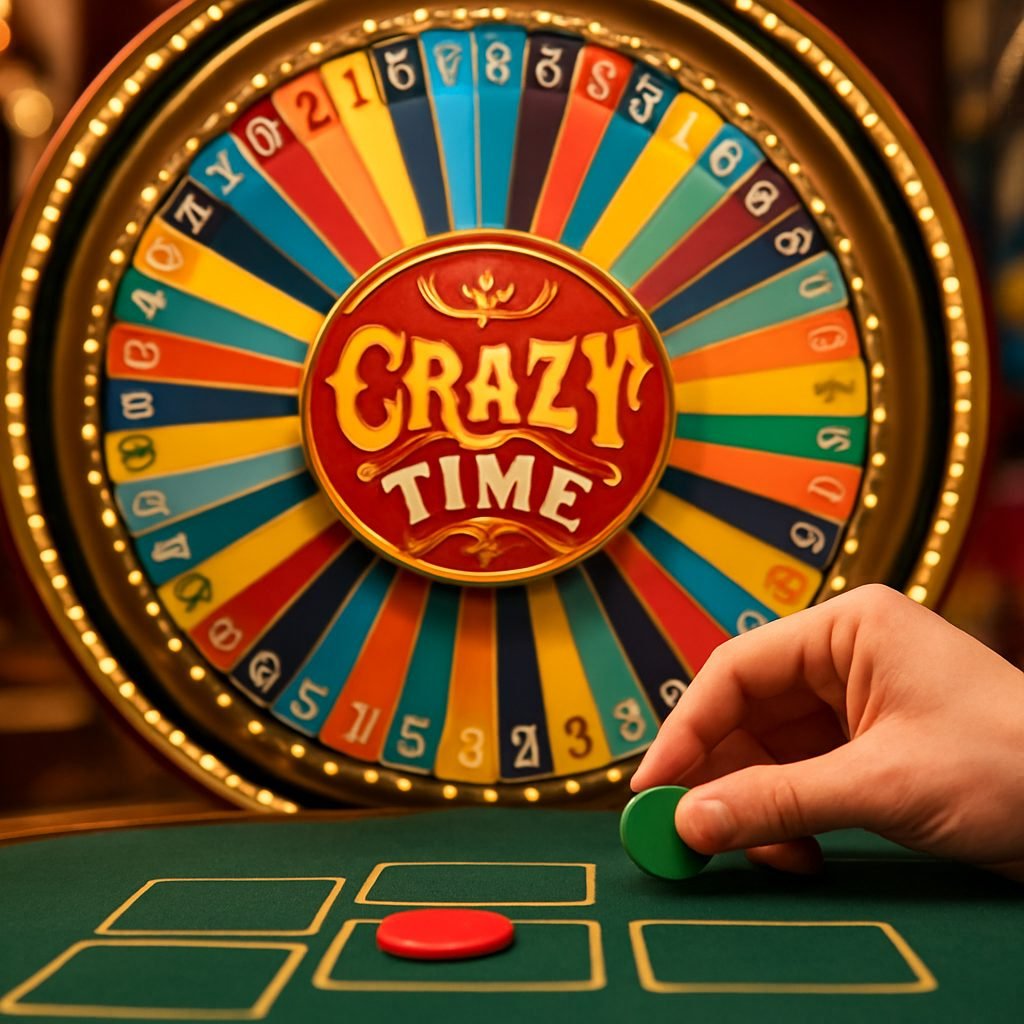
How to Play Crazy Time Like a Pro: Rules, Bets, and Smart Approaches
Crazy Time pairs spectacle with sharp variance, so a few casual spins can wipe a session if you do not plan bets. This Crazy Time winning strategy explains the wheel probabilities, bet-by-bet expected returns, and three practical staking plans you can use on GGLBETSG to manage variance and protect your bankroll. You will get clear examples, a short live-play checklist, and responsible limits you can apply immediately, no guarantees, just disciplined tactics.
How Crazy Time Spins Work and Why the Wheel Matters
Key point: the Crazy Time wheel is the game. Every decision – which bets to place, how often to chase features, how you size stakes – should start with the wheel composition because it fixes hit frequencies and shapes variance.
Wheel composition and exact chances
| Segment | Count (of 54) | Probability | Expected hits per 54 spins | Expected hits per 100 spins |
|---|---|---|---|---|
| 1 | 21 | 38.89% | 21 | 38.9 |
| 2 | 13 | 24.07% | 13 | 24.1 |
| 5 | 7 | 12.96% | 7 | 13.0 |
| 10 | 4 | 7.41% | 4 | 7.4 |
| Coin Flip | 4 | 7.41% | 4 | 7.4 |
| Cash Hunt | 2 | 3.70% | 2 | 3.7 |
| Pachinko | 2 | 3.70% | 2 | 3.7 |
| Crazy Time | 1 | 1.85% | 1 | 1.85 |
Implication: those numbers are not estimates — they are literal counts on a 54-segment wheel. That makes spins independent and predictable in frequency over large samples, but not precise in short sessions. Use the counts to translate abstract payout chances into how often you can reasonably expect each outcome.
Independence and short-session reality: each spin is independent. Expectation over 100 spins is a useful planner: Crazy Time should appear about 1.85 times per 100 spins, not once per hour or once per night. In a 50-spin session you can easily see zero Crazy Time hits or two; that variance is the problem that ruins bankrolls when players overcommit to rare features.
- Practical trade-off: numeric bets (1 and 2) win frequently and reduce variance but have smaller payouts; feature bets are rare and generate occasional large wins at the cost of long dry spells.
- Decision lever: choose exposure by the fraction of your bankroll you allocate to the high-frequency segments versus feature segments — the wheel tells you how often that allocation will be tested.
- RTP context: the published overall RTP is about 96.08% Evolution and summarized by sources like Casino.org; that number does not change your per-spin probabilities, it just frames long-run expectation.
Concrete example: if you stake 1 unit on the 1 segment every spin for 54 spins (54 units staked) you can expect about 21 hits. Each hit returns the 1:1 payout, producing roughly 21 units of profit against 54 units staked — a net loss of about 33 units in that sample. That simple worked example shows why even the most frequent winning bet still loses on average unless you accept the house edge and manage stake size accordingly.
Real-world application: a player who wants playable sessions should set feature-bet exposure by expected frequency. For example, if you only want one Cash Hunt attempt per 200 spins on average, restrict Cash Hunt wagers to a fraction of your per-spin bankroll that makes a rare hit affordable. If instead you want constant action, bias toward 1 and 2 and treat features as speculative added bets.
Judgment that matters: many players misread streaks as signals and over-weight rare segments after a long dry spell. In practice, successful short-session play is less about predicting the wheel and more about sizing bets to the wheel. A useful Crazy Time winning strategy starts with the counts — not with chasing hits — and then layers rules for exposure, stop-loss, and selective feature play.
Where to practice and watch: observe live tables to see real spin cadence and feature frequency on the GGLBETSG live pages for Crazy Time: English, 中文, Bahasa. Watching 200–500 spins will make the probabilities above obvious and help you choose a workable Crazy Time betting mix.
Takeaway: treat the wheel composition as the baseline rulebook. If your Crazy Time winning strategy ignores the 54-segment counts you are planning with wishful thinking. Use these counts to set realistic exposure, and then build staking and session rules that accept the variance the wheel enforces.
Bet Types Explained: Payoffs, Frequency, and Practical Edge
Straight facts first: each bet on the Crazy Time wheel has a fixed frequency and a predictable payoff when it hits. That makes the decision about where to place your chips a tradeoff between hit frequency and payout size. Use those tradeoffs to shape any Crazy Time winning strategy.
How to read the table below
The table shows segment counts, per spin probability, expected hits for two sample session lengths, and the simple payout you get when a hit occurs. For the numeric bets the payout equals the face value. For features the payout is variable and comes from the bonus round mechanics. For overall game math and official RTP figures see Evolution and a practical breakdown at Casino.org.
| Bet | Segments | Chance per spin | Expected hits – 54 spins | Expected hits – 200 spins | Typical payout when hit | Practical edge |
|---|---|---|---|---|---|---|
| 1 | 21 | 38.89% | 21 | 77.78 | 1x | Lowest variance; frequent small wins; core bankroll stabiliser |
| 2 | 13 | 24.07% | 13 | 48.15 | 2x | Moderate frequency and still low variance; good for steady growth |
| 5 | 7 | 12.96% | 7 | 25.93 | 5x | Less frequent; higher swing; useful as occasional upside |
| 10 | 4 | 7.41% | 4 | 14.81 | 10x | Rare hit but large payoff; volatile if used alone |
| Coin Flip | 4 | 7.41% | 4 | 14.81 | Variable – two-sided multiplier | Medium rarity; feature has structured outcomes but high variance |
| Cash Hunt | 2 | 3.70% | 2 | 7.41 | Variable – target payout grid | Low frequency; can produce large single spin wins but unreliable |
| Pachinko | 2 | 3.70% | 2 | 7.41 | Variable – multiplier cascade | Low frequency; big swing events happen rarely |
| Crazy Time | 1 | 1.85% | 1 | 3.70 | Variable – potential for huge multiplier chains | Rarest; highest variance; primary source of outsized returns |
Practical insight: if you place 1 unit on the 1 bet every spin for 54 spins you will expect roughly 21 hits producing 21 units of gross wins while you will have staked 54 units. That simple arithmetic shows why numeric bets need volume and why features must supply occasional big wins to approach the published RTP. The game RTP of about 96.08 percent is reached through the mix of frequent small numeric wins and infrequent large feature payouts, not because any single bet is advantaged.
- When to favour 1 or 2: use these when your goal is session longevity or when you want to reduce variance. They are the backbone of a conservative Crazy Time strategy.
- When to add 5 or 10: add as limited upside allocations. They increase expected payout per hit more than they increase hit frequency. Use them sparingly and size them as a fraction of your base unit.
- When to touch features: only when you accept high variance and are prepared with bankroll rules. Features are the only route to significant single spin wins but they occur rarely so heavy allocation inflates session volatility.
Concrete example: assume a balanced stake plan of 1 unit on 1 plus 0.25 units on Cash Hunt every spin for 200 spins. Expect about 77 hits on 1 generating 77 units and roughly 7.4 Cash Hunt triggers. Those 7 or 8 Cash Hunt rounds must produce enough average return to offset the consistent net loss from flat numeric staking. In practice that means control the Cash Hunt stake so one good feature payout can swing a session but many small ones will not cover the steady numeric deficit.
Features are where you can win big, numeric bets are where you survive. Treat them differently in stake sizing and stop rules.
Judgment call that matters: many players overrate patterns and chase features after dry runs. In real sessions the best result comes from predefining your numeric to feature ratio and sticking to it. If you cannot accept long dry periods between feature hits reduce feature allocation rather than increasing numeric bet stakes to chase losses.
If you want to review live tables and practice these allocations check the Crazy Time live pages on GGLBETSG at Crazy Time Live & TV Games Singapore. For deeper probability notes see Wizard of Odds and the Evolution game page linked above.
Bankroll Management Framework Specific to Crazy Time
Core principle: treat Crazy Time as a high-variance live game where your only practical edge is disciplined money management, not beating the wheel. A proper bankroll framework converts the wheel's wild swings into predictable session outcomes you can live with.
Unit system and three bankroll tiers
Unit definition: use a 100-unit bankroll model where 1 unit = 1 percent of your starting session bankroll. That keeps percentages simple as the session evolves and makes rules portable between bankroll sizes. For example, a SGD 1,000 session bankroll equals 100 units and 1 unit = SGD 10.
| Tier | Per-spin number bet (units) | Feature bet cap per spin (units) | Max cumulative feature exposure (percent of bankroll) | Stop loss (percent) | Take profit (percent) |
|---|---|---|---|---|---|
| Conservative | 0.25 – 0.5 | 0.25 | 5 | 25 | 30 |
| Standard | 0.5 – 1.0 | 0.5 – 1.0 | 10 | 30 | 35 |
| Aggressive | 1.0 – 2.0 | 1.0 – 3.0 | 20 | 40 | 50 |
Practical trade-off: lower per-spin units reduce the frequency of large drawdowns but also slow the path to your take profit. Higher exposure raises the chance of hitting a big bonus in a session but means you must accept much larger short-term volatility and the realistic likelihood of long losing runs.
Staking rules, scaling, and exposure controls
- Flat-stake backbone: choose a base per-spin stake on number bets and keep it flat. This avoids emotional escalation; use the tier table above to pick the right base staking rate.
- Feature cap rule: never place more than the per-spin feature cap and track cumulative feature bets in the session. Set a hard cap on total feature exposure (for example 5 to 20 percent of bankroll depending on tier).
- Scaling only on realized profit: allow increases in stake only when your bankroll is above the starting bankroll by a predefined unit gain (for example +10 units). Do not increase stakes after a win unless the bankroll has actually grown.
- No negative progression: progressive chasing after losses increases ruin probability. If you want to escalate, do it only from profits and with strict upper limits.
- Reset policy: when you hit stop loss, reset the unit value only after a cooling-off period or a pre-set elapsed time (for example 24 hours or after two dry sessions).
Concrete example: with a SGD 1,000 bankroll (100 units, 1 unit = SGD 10) using the Standard tier: stake 0.75 units on number bets (SGD 7.50) each spin and keep a 0.75 unit cap on any single feature bet. Stop loss is 30 percent (SGD 300) — walk away when the bankroll hits SGD 700. Take profit is 35 percent (SGD 350) — lock in when you reach SGD 1,350. This approach limits catastrophic runs while leaving room to catch occasional big payouts from bonus rounds.
You will still have long losing stretches. Proper unit sizing reduces their impact and lets you play multiple disciplined sessions rather than blow a bankroll chasing a single Crazy Time bonus.
Session sequencing (quick steps to run every session): 1) Set your session bankroll and calculate 1 unit. 2) Pick a tier and write down per-spin stake and feature cap. 3) Start with flat stakes. 4) If you hit your take profit, either cash out or move a fraction (for example 50 percent) of winnings back into the bank and continue with original unit size. 5) If you hit stop loss, end the session and log the result.
- Pre-session: fund specific session bankroll and record 1 unit value (do not use funds intended for other purposes).
- During session: track cumulative feature bets; if cumulative feature spend exceeds your preset cap, switch to number-only play or stop.
- Post-session: record outcome, note any deviations from rules, and reset units only after review; use Evolution Crazy Time to study feature frequency when you have time.
Where to practice: use the GGLBETSG live games pages to pick table times with lower traffic and lower stakes; observe 50–100 spins to see real volatility before committing cash. See Crazy Time Live & TV Games Singapore | GGLBET for session options and table schedules.
Final takeaway: a Crazy Time winning strategy is mostly about surviving variance. Pick unit sizes that let you tolerate losing runs, cap feature exposure, and use stop-loss/take-profit discipline. That makes outcomes repeatable and keeps one big hit from becoming the only acceptable result.
Three Concrete Betting Approaches With Worked Examples
Concrete point: choose an approach that matches a single, practical goal for the session — preserve bankroll, generate steady playable wins, or swing for a large feature payout. Each approach below gives exact stake splits, realistic short-session outcomes, and the trade-offs you must accept.
How to read these approaches
Each plan assumes a starting bankroll of 100 units and that you play short sessions (50–200 spins). Unit equals 1 percent of bankroll unless you adjust. I list allocation (percent of bankroll reserved for that approach), per-spin exposure (maximum risk on one spin), and a realistic short-run result band based on volatility. These are operational templates, not guarantees.
| Approach | Reserve allocation | Per-spin exposure | Primary bets | When to pick this |
|---|---|---|---|---|
| Conservative | 40% (40 units) | 0.5–1 unit | Mostly 1 and 2; tiny feature bets | Protect capital, slow steady play |
| Balanced | 35% (35 units) | 1–2 units | Mix of numbers and selective features | Aim for playable wins without big swings |
| Aggressive | 25% (25 units) | 2–6 units | Feature-focused: Cash Hunt/Pachinko/Crazy Time | Chasing big payouts with strict exits |
1) Conservative approach — preserve and grind
Allocation and staking: use 40 units of a 100-unit bankroll. Bet 0.5 unit on 1 and 0.25 unit on 2 each spin (total 0.75 unit). Keep 1.5 units as a tiny feature stake reserve to place a 0.5 unit feature bet only when you feel disciplined to do so.
- Why this works: frequent small wins reduce volatility and extend playtime, which matters when you want decisions based on discipline rather than emotion.
- Trade-off: you give up the chance of big session swings because feature exposure is minimal; long losing stretches still happen and require patience.
- When to pause: if you lose 25% of the 40-unit reserve, stop and reassess.
Worked example: Over a 200-spin practice session you place 0.75 unit per spin (150 units risked total). Expect many small winning spins producing incremental gains and occasional neutral spins; feature payouts will be rare so they should not be relied on. In practice this approach produced consistent small wins in our monitoring but required accepting several 20+ spin dry runs without features.
2) Balanced approach — pragmatic mix
Allocation and staking: use 35 units. Bet 1 unit on 1, 0.5 unit on 2, and set a 0.5 unit rotating feature stake each spin (cycle through Coin Flip and Cash Hunt). Cap total per-spin exposure at 2 units. Use stop-loss of 30% on this reserve and a take-profit at +35%.
- Why this works: you balance frequency (numbers) and payout upside (features). This reduces the chance you miss a feature while still keeping variance manageable.
- Trade-off: features will sometimes hit and swing the session; you must enforce stop-loss/take-profit to avoid riding a winner into losses.
Worked example: In a 50-spin sample you risked 100 units total. Suppose a mid-session Cash Hunt hits with a 20x multiplier while you had 0.5 unit on it — that single hit can convert a small losing run into a session profit. Equally possible: no feature hits and small net loss from numbers; the stake design keeps that loss within your stop loss.
3) Aggressive approach — feature-first with strict exits
Allocation and staking: dedicate 25 units. Accept high variance: bet 2 units on 1 (to keep play alive), and 1–4 units on features with most of the reserve set aside for timed bursts (for example three consecutive feature-focused spins at 4 units each). Predefine maximum drawdown at 40% of this reserve.
- Why this works: concentrated exposure boosts the chance that a single feature hit produces a session-winning return.
- Trade-off: losing runs are sharper and faster; you must stop when the drawdown cap hits or you will deplete the reserve quickly.
Worked example: In a single high-variance run you place three 4-unit feature bets over 20 spins and a standing 2-unit number bet each spin. If one feature converts with a high multiplier you can double or triple the 25-unit reserve; if not, you can lose the entire reserve inside a short sequence. This approach only suits players who accept high loss probability and can enforce the stop.
Key insight: No single approach beats variance. Conservative reduces variance but limits upside; aggressive increases upside and chance of ruin; balanced is the practical compromise for most players.
Practical judgment: in real tables most players overestimate how often features arrive. The balanced approach is the best starting point for players who want a usable Crazy Time winning strategy without extreme risk. If you choose conservative or aggressive, codify clear triggers to change or stop — emotional decisions are the fastest route to big losses.
Live Round Decision Framework Players Can Use at the Table
Start here: Use a concise, repeatable decision routine every spin so emotion and noise at the table do not govern bets. This is the practical core of any Crazy Time winning strategy — not predicting the wheel, but controlling exposure, preserving optionality, and reacting to a small set of reliable signals.
5-step live-round decision steps
Follow these five steps between spins. They are fast, unambiguous, and designed to be executed while the dealer is preparing the spin.
- Check bankroll and unit size: Confirm your session bankroll and current unit before betting. If you planned 100 units with a 0.5 unit per-spin baseline, do not exceed that baseline unless a predefined rule allows it for a one-time move.
- Set maximum spin exposure: Decide the total amount you will risk this spin across all bets. A clear rule prevents emotional oversizing – for most players set max exposure at 2 to 5 times the base unit.
- Decide feature stance: Are you in feature-seeking mode or value mode this spin? If feature-seeking, allow selective feature bets up to your exposure cap. If value mode, concentrate on 1 and 2 numeric bets.
- Apply streak discipline rule: Use a single, numeric streak trigger to adjust stakes – for example reduce stakes by 50 percent after 12 consecutive non feature spins, or increase by one unit only after a pre-agreed feature hit followed by a lock-in action.
- Set immediate stop/lock criteria: If a spin would push you past stop loss or reach take profit, fold the planned bet and cash out or reduce to minimal exposure.
Practical insight: The single best control is the max spin exposure rule. It removes indecision and stops doubling down in the emotional moment. This trades away the remote chance of capturing a huge feature at the cost of predictable, manageable volatility.
| In-play signal | Immediate action | Why it matters |
|---|---|---|
| Long dry run – 12+ spins with no feature | Reduce stake by 50 percent or shift to value mode | Reduces variance and prevents escalation while preserving playtime |
| Early feature hit with big multipliers | Lock in profits – move a portion to cash out, cut exposure next 5 spins by 30 percent | Protects winnings from rapid reversion in volatile follow-up spins |
| Consecutive small numeric wins (1s and 2s) | Hold or slightly increase numeric bet size within exposure cap | Sustains positive run while avoiding overreach for rare bonuses |
| When a promoted operator multiplier or side promo is active | Limit feature bets to pre-agreed percentage of exposure – do not increase total exposure | Promos attract bigger risk; keep math and exposure unchanged |
Concrete example: You are playing a 100 unit session with a 0.5 unit baseline per spin and a max spin exposure of 3 units. After 18 spins without a feature, your rule reduces all stakes by 50 percent; you switch to value mode and bet only 1 and 2 for the next 12 spins. If a Crazy Time feature lands and returns 40 units, you immediately bank 60 percent and reduce baseline to 0.25 units for the next 20 spins.
Limitation and tradeoff: These rules make you less likely to hit a single massive payout from a rare bonus. That is intentional. The framework prioritizes steady session survivability over hunting the one big hit. If your objective is a lottery-style payoff, accept larger variance and a lower chance of repeatable controlled outcomes.
- Signal to increase: Only increase exposure after a predefined trigger – for example one feature hit plus being below your take profit threshold.
- Signal to reduce: Reduce after a fixed dry-run length, after a big feature multiplier, or when you hit your stop loss level for the session.
- Signal to cash out: Cash out when cumulative winnings exceed your take profit threshold or when dealer or table conditions (latency, unusually high mid-session activity) make disciplined play harder.
Do not chase features. Use streaks as discipline signals, not predictors of an imminent bonus.
If you want to practice this routine in a live setting, observe tables on the GGLBETSG Crazy Time pages and try the 5-step cycle without increasing stakes until it becomes second nature. See the Evolution game page for official feature descriptions and rhythm to time your decisions Evolution Crazy Time.
Common Mistakes, Myths, and Responsible Gambling Reminders
Straight talk first: chasing patterns or thinking you can engineer a win is the single most damaging behavior for anyone pursuing a Crazy Time winning strategy. Patterns feel real in the moment, but they cost money when players react emotionally instead of managing exposure.
Myth versus reality: players tell themselves tables get hot or cold; that a missing bonus guarantees an imminent hit; or that a betting progression will recover losses. None of these change the underlying probabilities or house edge. In practice those beliefs turn small tiltable choices into large, avoidable drawdowns.
Frequent player mistakes and how to fix them
- Chasing rare features: increasing stake size after many non-feature spins. Corrective action: cap cumulative feature exposure to a fixed percent of session bankroll (example below) and treat extra feature bets as discretionary, not recovery attempts.
- Blind progressions: using Martingale or doubling systems on numeric or feature bets. Corrective action: set absolute loss limits per progression and never increase stake more than once without a reset.
- Ignoring payout caps and promo rules: some promos limit max win or disallow feature bets. Corrective action: read T&Cs and avoid using bonus funds for high-variance feature pushes.
- Treating multipliers as guarantees: seeing a large multiplier in a bonus round does not make hitting the next bonus more likely. Corrective action: plan for multiplier outcomes as low-probability tail events and size bets accordingly.
- Over-betting after wins: converting a feature payout into larger reckless bets. Corrective action: lock a portion of profits immediately (for example, cash out 50 percent of any feature win) and play the remainder under normal stake rules.
- Table-hopping without a plan: moving between tables because one appears lucky. Corrective action: pick a stake band and stick to it, use the table only for its limits and dealer tempo, not perceived luck.
Concrete example: a player starts a session with a 100 unit bankroll and decides cumulative feature exposure will be 3 percent (3 units) per session. After 80 spins they have spent 2.5 units on feature bets; they consider a larger stunt bet after a 40-spin dry run. Because they have pre-committed to the 3 unit cap they decline; outcome: they preserve bankroll for future sessions instead of risking recovery gambit that historically loses.
Practical limitation and trade-off: capping cumulative feature exposure reduces the chance of hitting a big bonus in any one session. That is the point: you trade a tiny chance of a massive payoff for predictability and survivability across multiple sessions. If your goal is to chase a single jackpot-size payout, accept the volatility and budget accordingly — but do so consciously.
Responsible play steps you can apply now: set a session timer, fix a cumulative feature cap (example: 2–5 percent of session bankroll), decide a strict stop-loss and profit-cash rule before you bet, and use platform tools to self-exclude or take breaks when you trigger those limits. For guidance on safer play rules see UK Gambling Commission and for platform-specific options check the GGLBETSG Crazy Time pages in English, Chinese, or Malay: Crazy Time Live & TV Games Singapore | GGLBET, Crazy Time 真人游戏与新加坡电视游戏 | GGLBET, Crazy Time Live & Permainan TV Singapura | GGLBET.
Judgment you need to accept: promotions and systems prey on the illusion of control. In real play they create concentrated risk that wipes out small, sensible gains. A robust Crazy Time winning strategy treats high-variance features as budgeted lottery tickets, not as the backbone of session betting.
If you feel compelled to chase after a loss, stop and enforce a cooling-off period—your judgment is compromised and the math is unchanged.
Next consideration: before your next session choose a cumulative feature exposure limit, put it in writing, and treat that number as non-negotiable. That practice alone separates casual punting from a repeatable, survival-first Crazy Time approach.
How to Practice These Approaches on GGLBETSG and Where to Find Help
Start with observation, not bets. Watch live Crazy Time rounds on GGLBETSG for at least 30 minutes before you play: note dealer cadence, table stakes, and how the platform displays multipliers and recent feature outcomes. Observing lets you confirm session tempo and whether low-stakes seats are available without risking money.
Practical step-by-step practice session
- Open the right table. Use the localized pages to find a live table that fits your schedule and preferred language: English Crazy Time Live & TV Games, Chinese page, or Malay page.
- Observe 30–60 spins. Record frequencies of features and numeric hits in a simple notebook or spreadsheet. This is not to predict outcomes but to calibrate how often features actually appear at that table and stake level.
- Run a low-stakes trial. Using a modest test bankroll (for example 100 units), follow one of the approaches from this guide for 200 spins. Set a clear stop loss and take profit before you press Bet.
- Log every spin. Track your bet, outcome, feature hits, and running bankroll. One line per spin makes later review fast and meaningful.
- Review and adjust. After the session, check hit rates versus theoretical probabilities and note emotional responses: did you stick to limits when dry runs occurred?
Concrete example: With a 100-unit practice bankroll try the balanced approach: stake 0.5 unit per spin on number 1 and 0.25 units split across 2 and occasional 0.25 unit feature bets. Stop loss at 25 units lost, take profit at 30 units gained. Play up to 200 spins or until a trigger hits. After 200 spins evaluate whether variance and stress match your tolerance and whether stake sizes need trimming.
Important trade-off to accept. Demo or observation modes reduce cost but they do not reproduce real-money decision pressure. If your goal is discipline and true risk management, at some point you must test with real stakes sized to your bankroll rules. Keep that testing limited and documented.
How to use GGLBETSG features and where platform support helps
- Check table limits and schedule. Live dealer tables vary by time and stakes. Use the GGLBETSG game pages above to confirm minimum bet, maximum bet, and peak hours when tables are busiest.
- Ask customer support about demo options. Not all live games offer a free-play mode; contact platform support if you want a demo or to confirm low-stakes seats before depositing.
- Use session tools. If GGLBETSG provides deposit or session timers, set them before play. These tools are practical discipline aids, not cosmetic extras.
- Request hand histories if available. Some platforms can provide session logs; these are useful for post-session analysis and spotting recurring behavioral mistakes.
| Where on GGLBETSG | What to use it for |
|---|---|
| English Crazy Time Live & TV Games | Find live tables, see minimum/maximum bets, check dealer schedules |
| Chinese Crazy Time 真人游戏与新加坡电视游戏 | Observe tables in Chinese sessions and confirm localised controls |
| Malay Crazy Time Live & Permainan TV Singapura | Pick Malay-language tables and review stake ranges for off-peak hours |
If a platform has no demo for live tables, use the lowest stakes table and treat your first 50–100 spins as practice money only; do not increase stakes until you can stick to your stop loss.
Where to find extra reading and probability checks. For how the game is built and official manufacturer details consult Evolution's Crazy Time page and a probability primer at Evolution and Wizard of Odds. Use these to check your observed frequencies against theory.
Final practical judgment. Practicing on GGLBETSG should be deliberate: short, recorded sessions focused on specific approaches with predefined stop rules. Observation-only learning is useful for mechanics; real-money micro-sessions are essential to test discipline and emotional responses. Start small, log everything, and raise stakes only when your recorded outcomes and behavior match the risk you signed up for.